
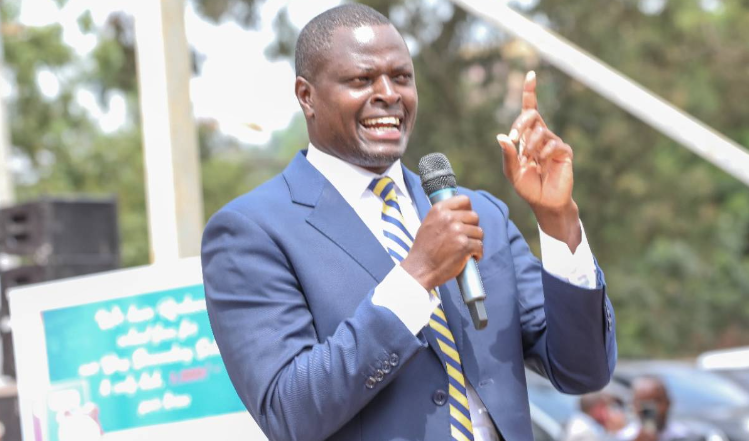
Kiharu MP Ndindi Nyoro will stay out of Parliament for five sitting days after refusing to apologise over his Kenya Pipeline IPO claims.
National Assembly Speaker Moses Wetang’ula announced the suspension on Wednesday.
The decision followed a heated debate in which lawmakers asked Nyoro to withdraw his remarks.
The Kiharu MP had claimed that public institutions faced pressure to invest in the Kenya Pipeline Company IPO.
Nyoro claims officials faced pressure
Nyoro made the claims during a debate on Tuesday.
He alleged that officials at several public institutions received calls from “the high office.”
According to the MP, the calls pushed the institutions to invest in the Kenya Pipeline IPO.
Among the institutions he named were the National Social Security Fund (NSSF), Public Service Superannuation Fund (PSSF) and Kenya Re.
The lawmaker claimed the institutions invested after the IPO came close to failing.
His remarks sparked a heated debate when Parliament resumed discussions on Wednesday.
Majority Leader Kimani Ichung’wah and Minority Leader Junet Mohamed challenged Nyoro to provide evidence.
Junet told the Kiharu MP to either support his claims with evidence or apologise to the House.
“There are matters that you can say at funerals and others that you can say on the floor of the House. But if you say something on the floor of the House, you must substantiate,” Junet said.
He also asked Nyoro to table evidence showing that the alleged phone calls took place.
Ichung’wah defends Kenya Pipeline investment
Ichung’wah accused Nyoro of misleading Parliament with his claims.
The Majority Leader cited documents showing that PSSF had gained from its Kenya Pipeline investment.
According to Ichung’wah, PSSF recorded a 5.1% gain on its Kenya Pipeline shares as of June 30.
He also warned that Nyoro’s remarks could harm the reputation of professionals working in public institutions.
Ichung’wah argued that lawmakers should not accuse public officials without evidence.
The Majority Leader further rejected Nyoro’s reference to “high offices” directing public investments.
Nyoro refuses to apologise
The lawmakers’ demands prompted Speaker Wetang’ula to order Nyoro to apologise.
However, the Kiharu MP stood by his remarks and refused to withdraw them.
“Honorable Speaker, what I stated is the truth, and the truth rides higher than the rules. And, therefore, I can’t apologize for the obvious,” Nyoro said.
Wetang’ula then found Nyoro guilty of gross disorderly conduct.
As a result, the Speaker handed him a five-sitting-day suspension.
“Honorable Ndindi, you are now guilty of gross disorderly conduct. And I’ll give you the most lenient of the provided punishments and exclude you from the House for five sitting days,” Wetang’ula said.
He added that Nyoro would remain a stranger in the House during the suspension.
Nyoro stands by Kenya Pipeline claims
Speaking to journalists later, Nyoro described the suspension as unfortunate.
The MP said Parliament had punished him for speaking what he believed was the truth.
He also argued that lawmakers had not given him enough time to substantiate his claims through parliamentary procedures.
Nyoro maintained that political offices should not influence investment decisions involving pension funds and independent institutions.
Once again, he claimed that NSSF, Kenya Re and PSSF faced pressure to invest in Kenya Pipeline.
According to the lawmaker, the investments have not delivered strong returns.
He cited the Kenya Pipeline share price, which he said stood at KSh9.02.
Nyoro compared the reported share performance with the country’s inflation rate.
In his view, the difference showed that the investment had delivered a poor return.
Nyoro vows to keep scrutinising public funds
Despite the suspension, Nyoro said he would continue examining how public institutions manage taxpayers’ money.
He urged NSSF, Kenya Re, PSSF and other public bodies to follow the Constitution when making investment decisions.
The Kiharu MP also told the institutions to reject political pressure.
Nyoro maintained that public funds should serve the interests of Kenyans.
Going forward, he said he would continue raising questions about how public institutions use and invest public resources.