

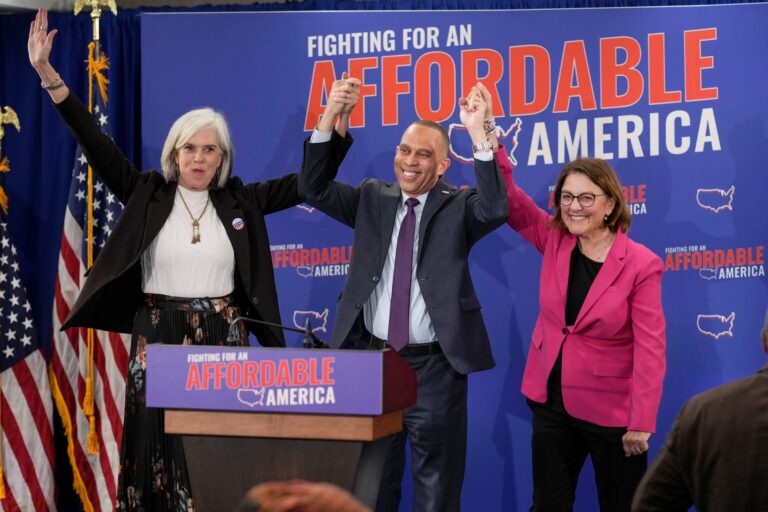
Democrats have taken control of both chambers of the US Congress after a sweeping midterm election victory that significantly changes the balance of power for the final two years of President Donald Trump’s term.
The party captured the House of Representatives and regained the Senate after winning a series of closely watched races, including contests in several states that had traditionally favoured Republicans.
Also Read



Democrats take House and Senate
Going into the election, Republicans held narrow majorities in both chambers.
Democrats needed only a small number of House gains to reach the 218 seats required for a majority, while the Senate presented a tougher challenge because Republicans entered Election Day with a 53-47 advantage.
By early Wednesday, the outcome had become clear enough for major US news organisations to call control of both chambers for Democrats.
The result means Trump will face a divided government for the remainder of his presidency, with the opposition controlling the legislative branch.
Senate gains extend into Republican territory
One of the most striking features of the election was Democratic success in states that have traditionally leaned Republican.
The party won Senate contests in Texas, Kansas and South Carolina, while also making gains in North Carolina and other battlegrounds.
In Texas, Democrat James Talarico won the Senate race after a highly competitive Republican campaign.
South Carolina also elected a Democratic senator, while Roy Cooper secured victory for the party in North Carolina.
Democrat Jon Ossoff, meanwhile, retained his Senate seat in Georgia.
Trump agenda faces stronger resistance
Democratic control of Congress is expected to make it considerably harder for Trump to advance major legislation without opposition support.
The House will give Democrats control of congressional committees, allowing them to hold hearings, issue subpoenas and investigate the administration.
Senate control will also give the party greater influence over the confirmation of senior officials and federal judges.
However, Democrats do not have the large Senate majority required to overcome every procedural obstacle, and Trump retains the presidential veto.
The result therefore raises the prospect of political gridlock, particularly on legislation where the White House and Congress remain far apart.
Economy weighs heavily on voters
The midterms took place amid widespread concern over the cost of living, tariffs and the economic effects of the continuing conflict involving Iran.
Reuters reported that voter dissatisfaction over rising prices was one of the major issues working against Republican candidates during the campaign.
Exit polling cited by Reuters also showed that many voters viewed the election as an opportunity to place stronger checks on the president.
Trump’s approval ratings had remained low in the weeks leading up to the vote, adding pressure on Republican candidates campaigning in competitive districts and states.
Republicans suffer setbacks in key races
Republican candidates backed by Trump struggled in several important Senate contests.
Reuters reported losses for Trump-supported candidates in South Carolina, North Carolina, Texas and Michigan, races that contributed directly to the Democratic takeover of the Senate.
The results have also opened debate within the Republican Party over candidate selection and campaign strategy ahead of the 2028 presidential election.
Trump, however, has rejected suggestions that he bears responsibility for the party’s losses.
Democrats gain new leverage over White House
Control of Congress will give Democrats significant new powers when lawmakers return to Washington.
They will be able to influence federal spending negotiations, challenge White House priorities and increase oversight of government departments.
Congressional investigations into the Trump administration are also possible, although the exact priorities of Democratic leaders have yet to be fully outlined.
Trump has indicated that he is prepared to use his veto against legislation he opposes, meaning major laws could require compromise between the White House and Congress.
Midterms reshape final two years of Trump presidency
The election fundamentally changes the political environment in Washington.
Trump began the midterms with Republican control of both chambers, giving his administration greater room to pursue its legislative programme.
He will now spend the remainder of his term dealing with a Congress controlled by the opposition.
For Democrats, the victory gives the party control of the legislative branch and a stronger platform heading into the 2028 presidential contest.